








Source: IMF
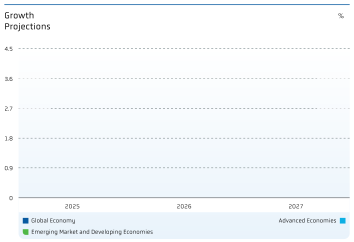
Global real gross domestic product (GDP) growth is projected at 3.3% in insert superscript 1 after 2026, broadly unchanged from 2025. Elevated trade tensions, high public debt, and geopolitical uncertainty continue to weigh on the outlook.
Advanced economies are projected to grow by about 1.8% in 2026, while emerging markets and developing economies are expected to grow at around 4.2%.
Global inflation is forecast to continue easing in 2026, although it remains above central bank targets in many major economies, influencing monetary policy decisions.
 Economic Performance of Sri Lanka
Sri Lanka entered 2025 with macroeconomic conditions materially better than the 2022-23 crisis period, underpinned by the International Monetary Fund (IMF) Extended Fund Facility (EFF) and domestic reforms (tax increases, cost-reflective utility pricing, tighter monetary financing rules, etc.). The year was characterised by continued recovery in real activity, very low inflation at the end of the year after a long deflation spell, improving external buffers helped by foreign exchange inflows from tourism and remittances, and continued high sovereign risk.
Source: Central Bank of Sri Lanka
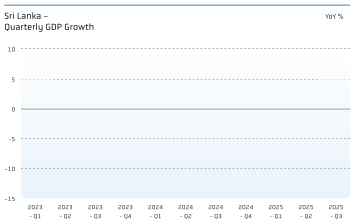
The economy grew by 4.8% in the first quarter (Q1) of 2025, 4.9% in Q2, and 5.4% in Q3. The Central Bank of Sri Lanka (CBSL) projects that Sri Lanka’s economy will grow by around 4.5% for the entire year 2025.
Multilateral financial institutions, such as the World Bank and IMF, project continued, moderate growth in 2026 as stabilisation takes hold. CBSL expects activity to remain on an improving trajectory, supported by ongoing reforms, investment, and tourism recovery.
Year-on-year inflation transitioned from negative readings for the most part of 2025 to low positive levels by the end of the year. Market interest rates broadly adjusted downwards in 2025. At the start of 2025, the exchange rate was around LKR 293 per USD, and by the end of December, the rupee had weakened further with rates reaching approximately LKR 310 per USD, marking a net depreciation of roughly 5.8% over the year.
Tourism and Remittances
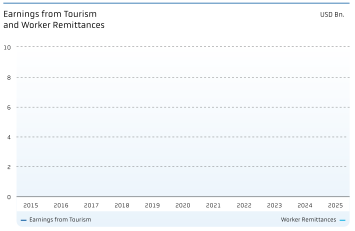
Sri Lanka recorded its highest-ever international arrivals in 2025, attracting approximately 2.36 million visitors, a 15% increase from 2024 (Sri Lanka Tourism Development Authority). Tourism earnings for 2025 amounted to USD 3,219.2 Mn. (2024: USD 3,168.6 Mn.), based on CBSL data. Despite the challenges posed by Cyclone Ditwah, tourist arrivals and tourism earnings are expected to remain on an upward trajectory in 2026.
Sri Lanka’s remittance inflows in 2025 amounted to USD 8,076.2 Mn., a 22.8% increase year-on-year compared with 2024 and the highest annual total on record, according to official data.
Source: Central Bank of Sri Lanka, World Bank
Key Trends in the Telecommunications Sector: Global and Asia-Pacific Perspectives
The convergence of telecommunications with artificial intelligence (AI), edge computing, and Internet of Things (IoT) technologies is creating new opportunities while disrupting traditional business models. Success in this evolving landscape will require telecommunications operators to transform from pure connectivity providers into platform-driven technology companies capable of delivering differentiated, and intelligent services across consumer and enterprise segments.
The telecommunications sector has emerged as one of the most critical drivers of global economic growth, serving as essential infrastructure that enables economic activity across virtually all industries. Recent data from 2024-2025 demonstrates unprecedented growth in the sector’s economic contribution, particularly driven by mobile technologies, 5G deployment, AI integration, and digital transformation across both global markets and the Asia-Pacific region. The industry faces the dual challenge of monetising significant infrastructure investments while preparing for next-generation technologies such as 6G. Building out the infrastructure to connect everyone adequately will cost hundreds of billions of dollars by 2030, with 2.6 billion people (roughly a third of the global population) remaining unconnected globally.
The Asia-Pacific region has emerged as the global epicenter of telecommunications growth and innovation. The region’s leadership in 5G deployment, aggressive infrastructure investment, and rapid technology adoption position it as the primary driver of global telecommunications evolution through 2030 and beyond. However, significant challenges remain. Rising spectrum costs, persistent digital divides, cybersecurity threats, and the need for sustainable operations require coordinated action from operators, regulators, and policymakers.
The global telecom services market was estimated at USD 1,983.08 Bn. in 2024 and is projected to reach USD 2,874.76 Bn. by 2030, growing at a compound annual growth rate (CAGR) of 6.5% from 2025 to 2030.
The telecommunications sector’s contribution to global GDP reached unprecedented levels in 2024-2025, with mobile technologies generating 5.8% of global GDP (USD 6.5 Tn.) and projected to reach 8.4% (USD 11 Tn.) by 2030.
In 2024, mobile technologies and services generated 5.6% of Asia-Pacific’s GDP, contributing USD 950 Bn. in economic value (GSMA, 2025). This represents a substantial increase from USD 880 Bn. (5.3% of GDP) in 2023 (GSMA, 2024). The mobile industry’s economic contribution is forecast to grow to USD 1.4 Tn. by 2030, equivalent to 6.6% of Asia-Pacific’s GDP, driven by continued expansion of 5G, IoT, and AI.
The mobile industry's contribution to the Asia-Pacific economy over the period 2023-2030 is expected to outpace the global average, growing by 15% in the region, compared to the global average growth of 12% over the same period.
Expanding meaningful and affordable connectivity will contribute directly or indirectly to accelerating progress towards 70% of the targets under the United Nations Sustainable Development Goals (SDGs). This underscores the telecommunications sector’s role not just in economic growth but in broader social development globally, particularly in developing regions of Asia-Pacific.
5G Expansion and Path to 6G
The deployment of 5G networks continues at an unprecedented pace globally. According to Ericsson’s Mobility Report (2024), global 5G subscriptions reached approximately 2.3 billion by the end of 2024, representing 25% of all global mobile subscriptions. More significantly, 5G subscription numbers are expected to overtake 4G subscriptions during 2027. By 2031, global 5G subscriptions are forecast to reach 6.4 billion.
The telecommunications industry has already begun preparations for 6G technology, with the first commercial deployments expected in the early 2030s. This preemptive positioning represents a strategic shift from traditional infrastructure roles to platform-driven ecosystems enabled by AI-enhanced radio networks and intelligent edge capabilities.
The Asia-Pacific region leads in both 5G deployment and adoption. Operators across Asia-Pacific invested nearly USD 220 Bn. in 5G networks between 2019 and 2024, with a further USD 254 Bn. committed through to 2030. 5G is expected to account for 50% of all mobile connections in the region by 2030, placing the Asia-Pacific region significantly ahead of many other global markets, with 5G already nearing mass-market levels in Australia, Japan, Singapore, and South Korea. India’s 5G subscriber base is projected to surge to 980 million by 2030 from 290 million in 2024.
Internet of Things (IoT)
Cellular Internet of Things (IoT) services represent an industry bright spot globally, with overall IoT revenue in the automotive sector projected to more than double between 2023 and 2028 to reach USD 34.1 Bn., rising at a CAGR of 15.8%. Every new electric vehicle (more than 17 million were sold globally in 2024) is essentially a mini data centre that comes with connectivity built in.
The number of IoT-connected devices in Asia-Pacific is expected to exceed 50 billion by 2030, requiring high-speed data connectivity to operate and communicate seamlessly.19 The region is at the forefront of IoT adoption, particularly in manufacturing, smart cities, and automotive sectors.
Artificial Intelligence and Digital Transformation
AI has emerged as a transformative force in telecommunications operations. The global AI in telecommunications market was valued at USD 2.7 Bn. in 2024, and is projected to grow at a CAGR of 32.6% between 2025 and 2034. Telecommunications companies are deploying AI for network optimisation, predictive maintenance, customer service automation, and fraud detection.
The Asia-Pacific region demonstrates strong AI investment momentum with substantial financial commitments. The International Data Corporation (IDC) forecasts that AI and generative AI investments in Asia-Pacific will reach USD 175 Bn. by 2028, growing at a CAGR of 33.6% from 2023 to 2028. More broadly, IDC predicts that AI spending will grow at 1.7 times the rate of overall digital technology spending in the next three years, generating an Asia-Pacific (excluding Japan) economic impact of over USD 1.6 Tn. by the end of 2027. The software and information services sector is leading the charge, accounting for over 40% of total AI spending in 2025.
Recent Developments in Sri Lanka’s Telecommunications Sector
In 2025, Sri Lanka’s telecommunications sector was defined mainly by the accelerated preparation for commercial 5G and a stronger state emphasis on digital infrastructure as part of the wider “digital economy” agenda.
In late 2025 and moving into 2026, the sector’s key breakthrough was the transition from trials and policy announcements to a licensed 5G era, driven by Sri Lanka’s first-ever spectrum auction and subsequent assignment of spectrum for IMT-2020 (5G) broadband services. The Telecommunications Regulatory Commission of Sri Lanka (TRCSL) confirmed that it conducted the country’s first spectrum auction and awarded 5G spectrum licences, marking a major national milestone in mobile broadband regulation and signalling that commercial network expansion could proceed under formal licensing. Overall, across 2025-2026, Sri Lanka’s telecommunications narrative shifted from policy and readiness to licensed rollout and public access, with TRCSL’s spectrum assignment acting as the central catalyst, and operators expanding both infrastructure and partnerships to convert 5G potential into mass-market connectivity.
Our Recent Contributions to Sri Lanka’s Economy
Advanced mobile technologies such as 5G are increasingly associated with productivity gains, particularly through improved network speed, low latency performance, and the ability to support high-demand digital services at scale. In January 2025, The Company conducted Sri Lanka’s first 5G-Advanced (5G-A) trial, with the demonstration taking place on 12 January 2025. This development is economically significant because 5G-A capability represents an upgrade
pathway for high-performance enterprise solutions and future digital services, strengthening Sri Lanka’s readiness for technology-intensive industries. Following the spectrum auction and awarding of 5G spectrum licences, The Company made its 5G network publicly accessible, thereby positioning 5G as a platform for nationwide digital transformation, and enabling improved user experience and future enterprise applications.
These technology deployments support the economy by improving connectivity for small and medium-sized enterprises (SMEs) and digital entrepreneurs, enabling better remote work infrastructure, strengthening digital education access and enhancing service-sector performance through high-quality network connectivity.
A further dimension of our economic contribution relates to the strengthening of Sri Lanka’s international connectivity infrastructure. For small, open economies, international bandwidth capacity and redundancy can influence competitiveness in trade, tourism, and especially digitally tradable services such as information technology (IT) and business process management (BPM). A major strategic milestone was the landing of the SEA-ME-WE 6 submarine cable in Matara at the end of 2024, which was a historic national achievement, with commercial operation expected by mid-2026. Improved submarine connectivity is important for economic growth, because it supports the reliability and scalability of international data flows, reduces bottlenecks, and strengthens the country’s ability to host and deliver global digital services. By enhancing network redundancy and capacity, such infrastructure supports export-oriented service sectors and can improve Sri Lanka’s attractiveness for foreign investment in data-driven industries.
Collectively, these developments reinforce our function as a strategic national digital infrastructure provider and a critical driver of modern economic transformation.
We play a central, state-aligned role in Sri Lanka’s digital transformation, acting as the national ICT infrastructure provider for both the government and the public. Its contribution spans core government platforms, education connectivity, and rural inclusion initiatives, all of which directly support the country’s push towards digital inclusion and a digitally enabled economy.
A key pillar of this contribution is the Lanka Government Network (LGN), which is designed, operated, and managed by the Company. The LGN serves as the digital backbone connecting government institutions across the island, enabling secure communication, data sharing, and integration of digital services across ministries and departments. Complementing this is the Lanka Government Cloud (LGC), also managed by SLT- Mobitel, which provides a centralised, scalable cloud infrastructure for government agencies. Together, these platforms enable e-government services, support advanced technologies such as AI and data analytics, and strengthen Sri Lanka’s move towards efficient, transparent, and digitally driven governance. For detailed information, please refer the section Trailblazing Infrastructure on pages 50 to 57.
In the education sector, we have played a significant role through national school fibreisation initiatives, connecting schools with high-speed broadband infrastructure. This enables access to e-learning platforms, digital content, and online classrooms, thereby reducing disparities between urban and rural education systems. By integrating schools into the national digital network, we contribute to long-term human capital development and ensures that students across the country can participate in a modern digital learning environment.
At the infrastructure level, we have undertaken large-scale fibre expansion projects, including initiatives such as the “One Million Fibre Project”, aimed at delivering high-speed broadband connectivity across Sri Lanka. This expanding fibre footprint supports not only households but also businesses, government institutions, and public services such as healthcare and education, forming the foundation for a digitally connected society.
Importantly, we have also focused on extending connectivity to rural and remote areas through programmes such as “Gamata Sanniwedanaya” and broader investments in mobile and broadband networks, including 4G and emerging 5G technologies. These efforts ensure that underserved communities gain access to reliable digital infrastructure, helping bridge the urban-rural digital divide. Improved connectivity in these regions enables access to e-government services, financial services, education, and new digital livelihood opportunities, thereby enhancing overall social and economic inclusion.
Beyond infrastructure, we further supported the government’s financial inclusion agenda by providing a core banking system to support SMEs, thereby reaching sub-rural areas of the country. By enabling businesses and communities to participate in the digital economy, the Company helps drive innovation, productivity, and economic growth. We also provided online connectivity for peripheral legal services at the Courts Complex in Hulftsdorp.
Overall, the Company functions as a strategic national enabler of Sri Lanka’s digital transformation. Through its role in government networks, education connectivity, nationwide fibre expansion, and rural inclusion programmes, it underpins the country’s digital ecosystem and supports the transition towards a more inclusive, connected, and digitally empowered society.
Our Contribution to Economic Resilience in the Aftermath of Cyclone Ditwah
In the aftermath of Cyclone Ditwah, which triggered severe flooding, landslides, and widespread disruption across multiple districts, we played a pivotal role in strengthening Sri Lanka’s economic resilience by restoring and stabilising the country’s core digital infrastructure. This ensured that businesses, public services, and emergency responders could continue functioning during the crisis and recover faster afterwards.
From the earliest hours of the disaster, the Company activated a coordinated national response using specialised engineering teams, regional operational structures, and emergency governance mechanisms to protect what it described as Sri Lanka’s “digital lifeline”. This is because network continuity is essential for maintaining access to banking and payment systems, supply-chain coordination, market communication, and public information flows during major shocks. A central pillar of this resilience contribution was the rapid protection and restoration of the Sri Lanka Backbone Network (SLBN), identified as the country’s most critical digital artery SLT-MOBITEL reported that only a limited number of backbone nodes were affected and that these were fully restored within 24 hours, preventing prolonged nationwide digital paralysis, and reducing the economic downtime experienced by communities and enterprises.
Beyond its own subscriber base, we positioned itself as a national enabler by prioritising restoration efforts that supported other operators and users, with the rapid recovery of its islandwide core network which acted as a catalyst for restoring both fixed and mobile connectivity across nearly all disaster-affected areas. This helped to re-establish the communications environment required for economic activity to restart. At the national coordination level, telecom operators, including the Company, worked closely with government authorities and partners to reconnect affected populations, reinforcing the role of reliable connectivity in keeping families connected, enabling rescue operations, and facilitating urgent public coordination at scale.
Our economic resilience impact also extended into social and health stabilisation, which directly influences labour productivity and recovery speed, through initiatives such as a 24/7 “247” National Medical Helpline launched with the University of Colombo to support communities facing injuries, infections, and other flood-related health risks. This helped to reduce secondary health shocks that often delay economic normalisation after disasters.
External Risks and Emerging Global Dynamics
As at the date of publication of this Report, escalating geopolitical tensions in the Middle East, including developments involving Iran, Israel, Lebanon, and the United States, continue to contribute to heightened global economic uncertainty. These developments have the potential to disrupt energy markets, global trade flows, supply chains, financial markets, and investor confidence, particularly through volatility in oil prices, inflationary pressures, and tighter global financing conditions.
For Sri Lanka, which remains in a gradual economic recovery phase, prolonged geopolitical instability could indirectly affect external sector performance, import costs, exchange rate stability, tourism flows, and overall business sentiment. As a digitally connected infrastructure provider operating within an increasingly globalised technology ecosystem, we recognise the potential implications for international bandwidth markets, technology procurement, cybersecurity risk exposure, and capital investment environments.
While these developments were not materially evident during the primary reporting period covered by this Annual Report, the Group continues to closely monitor emerging geopolitical and macroeconomic risks. Supported by a resilient national digital infrastructure, diversified connectivity platforms, disciplined financial management, and responsive operational capabilities, we remain committed to maintaining service continuity, operational resilience, and long-term stakeholder value creation amid evolving global uncertainties.
launched with the University of Colombo