








As the national ICT enabler, our strategic priority is to ensure uninterrupted telecommunication and core services that are woven into the fabric of society, enhancing conveniences of the community in its daily life. With the government’s digital drive in 2025 this was further heightened, emphasising the key contribution of the Company to achieve the nation’s macroeconomic goals.
Our infrastructure strategy proactively looks to strengthen Sri Lanka’s position as a regional telecommunications, cloud, and digital infrastructure hub by leveraging the Company’s extensive fibre backbone, advanced data-centre ecosystem, and integration with major international submarine cable networks. Supported by sustained financial strength, the Company prioritised network expansion, fibre backbone growth, 5G rollout acceleration, cloud enablement, data-centre upgrades, and strategic partnerships to enhance national connectivity, operational resilience, and scalable digital service delivery. Sri Lanka’s strategic location along key East-West undersea cable routes, combined with our carrier-grade infrastructure, low-latency connectivity, and renewable-energy-powered operations, positions the country as an attractive hub for hyperscalers, enterprise cloud adoption, edge computing, and digital commerce across Asia, the Middle East, and Europe. In addition, the nation’s geographical resilience and secure inland infrastructure locations further strengthen its potential to host resilient, disaster-resistant digital infrastructure, reinforcing our role in enabling globally connected, future-ready digital ecosystems and supporting Sri Lanka’s emergence as a strategic gateway in the global digital economy.
69,000 km (Approximately)
Nationwide Fibre Network
Tier III Certified Data Centre
Sri Lanka's First Purpose-Built Data Centre
5 Data Centres
Capacity-wise market leader in Sri Lanka
5 International Cables
with own capacity
295
(SLT and Mobitel)
Nationwide Reach and Customer Access
How We Impact SDGs


 Empowering Connectivity Through World – Class Infrastructure
Located at the crossroads of major East–West connectivity routes, Sri Lanka is steadily emerging as a strategic telecommunications, cloud, and data-centre hub serving Asia, the Middle East, and Europe. The country’s position along key global submarine cable corridors strengthens its role as an evolving regional gateway for international data traffic and digital infrastructure.
In line with this strategic advantage, the Company operates a robust international connectivity portfolio comprising five submarine cable systems with dedicated capacity. This includes three consortium cable systems linking Singapore to Europe, and two bilateral cable systems connecting Sri Lanka to India and the Maldives respectively. Together, these investments significantly enhance the nation’s international bandwidth capacity, network resilience, and low-latency connectivity.
These high-capacity global connections enable the Company to effectively support the accelerating demands of hyperscale cloud services, enterprise digital transformation, content delivery networks, and next-generation digital applications. By continuously strengthening its international infrastructure footprint, the Company reinforces Sri Lanka’s position as a trusted digital gateway and a strategically important node in global connectivity networks.
SLT Global Network
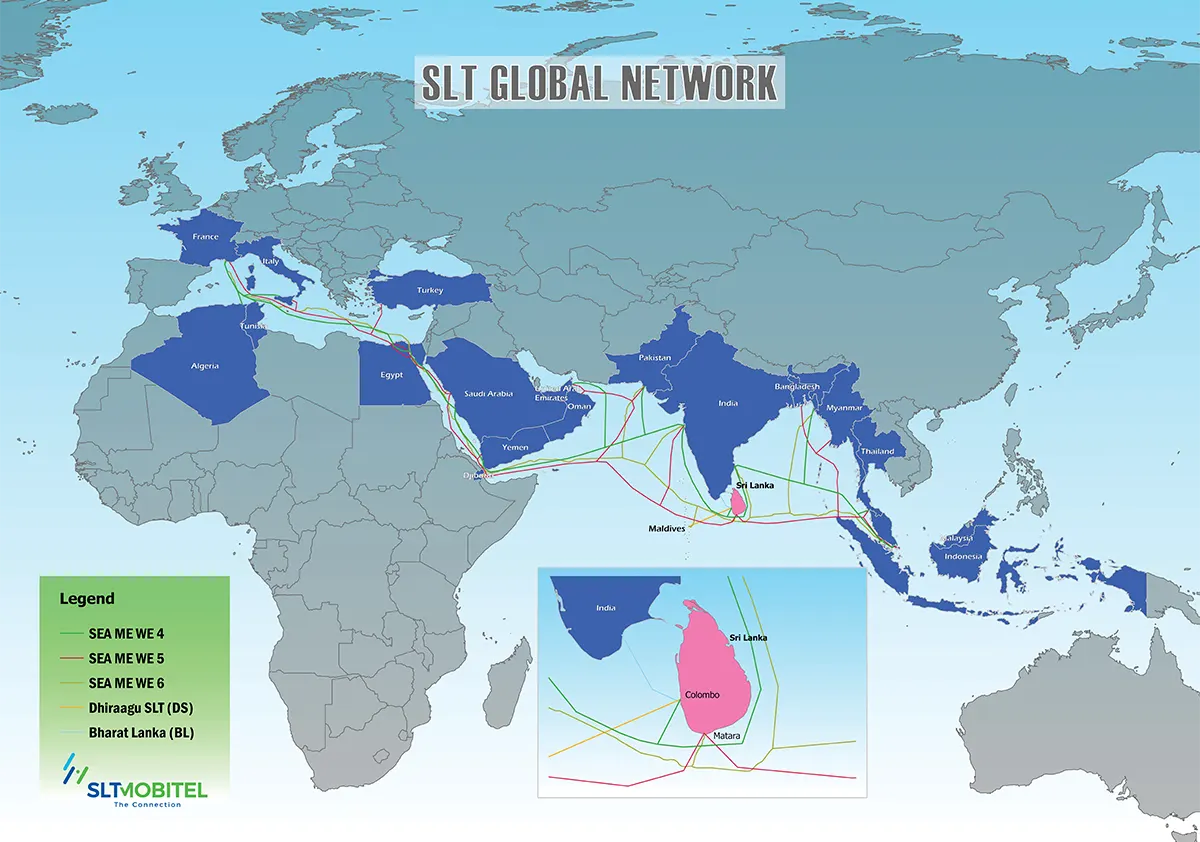
| Cable System | Landing Station | Connectivity Reach | Strategic Value |
| SEA-ME-WE 4 | Colombo | Southeast Asia, Middle East, Western Europe | High-capacity global data transmission |
| SEA-ME-WE 5 | Matara | Southeast Asia, Middle East, Western Europe | Advanced technology, enhanced resilience and bandwidth |
| SEA-ME-WE 6 Scheduled to be commissioned in Q1 2027 | Matara | Singapore to France (14 countries) | Next-generation hyperscale and cloudready infrastructure |
| Bharat Lanka | Mt. Lavinia | Sri Lanka to India | Regional traffic resilience and redundancy |
| Dhiraagu – SLT | Colombo | Sri Lanka to Maldives | Regional traffic resilience and redundancy |
Sri Lanka’s position along major East–West submarine cable routes strengthens its role as an emerging regional connectivity and digital infrastructure hub. Through multiple international submarine cable systems connecting Asia, the Middle East, and Europe, we continue to expand the country’s international bandwidth capacity, network resilience, and low-latency connectivity capabilities. These investments support the growing demands of hyperscale cloud services, enterprise digitalisation, content delivery, and next-generation technologies, while reinforcing Sri Lanka’s potential to serve as a strategic gateway for regional digital traffic and global connectivity.
Our Core Functions
Network Expansion and Capacity Upgrades
Expanding and densifying our national fibre network of approximately 69,000 km to increase backbone capacity and last-mile reach, we continued to work towards higher broadband penetration and enterprise connectivity. The strategy emphasised our resilience and redundancy leveraging multiple submarine cable landings, resulting in improved international bandwidth. The strategy reduced latency for business and government customers, and extended terrestrial routes impacting networking and connectivity.
The Strategy
Network expansion and capacity upgrades
Mobile network capacity coverage
Data centre capacity and cloud enablement
Strategic partnerships and ecosystem development
Mobile Network Capacity Coverage
We further expanded our Mobile Network footprint during the year through the deployment of new sites initiatives, strengthening nationwide mobile coverage and enhancing service reliability across both urban and regional areas. Significant upgrades to the Radio Access Network (RAN) and core transport infrastructure improved overall network capacity, enabling a superior customer experience while supporting growing demand for high-speed digital connectivity Meanwhile, we completed strategic spectrum realignment and optimisation initiatives to enhance network efficiency, capacity utilisation, and operational performance.
Our investments during the year focused on spectrum optimisation, infrastructure sharing, enhanced asset utilisation, and reliability improvement initiatives aimed at improving service quality and reducing congestion during peak usage periods. These initiatives strengthened the network’s readiness to support next-generation digital services while reinforcing our commitment to enabling inclusive national digital connectivity. Reflecting the success of these efforts and our leadership in delivering superior mobile performance, Mobitel was recognised as the “Best Mobile Network in Sri Lanka” by Ookla for the 2025 Q3 and Q4 period, based on network speed, video streaming quality, and web browsing experience.
The resilience of our network architecture and operational framework also enabled us to effectively manage disruptions arising from the Ditwah disaster situation during the year. Our Network Operations teams responded swiftly to restore connectivity in affected areas, ensuring continuity of telecommunication services and uninterrupted customer access during the period of disruption.
Building on the technical insights and operational expertise gained through earlier 5G trials, we successfully progressed towards the commercialisation of next-generation connectivity solutions during the year. As part of our long-term digital infrastructure strategy, we continue to position 5G as a key enabler of national digitalisation, with phased network expansion prioritising high-impact economic corridors, enterprise clusters, and digitally intensive regions.
Demonstrating continued technological leadership, we further advanced our 5G-Advanced (5.5G) capabilities through 3CC and 5CC carrier aggregation technologies, achieving broadband throughput speeds exceeding 10 Gbps for the first time in Sri Lanka. This milestone reinforced Mobitel’s position at the forefront of next-generation connectivity and digital innovation in the country.
In December 2025, we secured 100 MHz of 3.5 GHz spectrum at a value of LKR 5.175 Bn., becoming the first operator to commercially launch public 5G services in Sri Lanka. This strategic spectrum acquisition, together with continued investments in advanced 5G infrastructure, further strengthens our role as a key enabler of Sri Lanka’s digital transformation agenda and supports broader national development priorities. During the year, we also successfully transitioned our pre-commercial 5G network presence across 18 districts into a fully commercial 5G service network, marking a significant milestone in the evolution of the country’s digital connectivity landscape.
Our network resilience was demonstrated during the Ditwah disaster period, where services remained operational across most affected regions, particularly within the Central and Northern Provinces. Through coordinated efforts involving operations teams, network vendors, subcontractors, the CEB, security forces, and the TRCSL, full network restoration was achieved faster than industry peers, reinforcing customer trust and positioning Mobitel as one of Sri Lanka’s most reliable mobile networks.
Data Centre Capacity and Cloud Enablement
Delivering secure hosting, managed services, and scalable cloud solutions to enterprises and government agencies, we operate one of the most advanced data-centre and cloud ecosystems in Sri Lanka. Integrated with national fibre backcone, its carrier-grade facilities are designed to support mission-critical workloads with high reliability and professional support.
Firmly anchored in sustainability, 70% of our data-centre energy usage is sourced from renewable power. Renewable energy adoption continued across our network infrastructure, with more than 700 base stations converted to solar power. By end-2025, approximately 18% of total base stations were operating on renewable energy.
This not only reduces the carbon footprint of critical digital infrastructure but ensure sustainable resilience against energy consumption and cost escalations. Integrating green energy into high-availability facilities is a hallmark of the Company, demonstrating its commitment and leadership to align technological growth with environmental responsibility. While supporting national climate goals, this positions the Company as a future-ready institution to meet global demand for low-carbon and data-centre services.
Cloud Services
Our cloud services is a strategic convergence of carrier-grade infrastructure, sovereign data governance, and elastic compute paradigms that leverages the national fibre backbone and submarine cable connectivity. We continued to build its multi-tenet, hybridised cloud architecture integrating many platforms into a cohesive digital ecosystem, enabling scalable workload virtualisation, latency-optimised content delivery and compliance-aligned data residency. By embedding cyber-resilience frameworks, renewable energy powered data-centre operations, and AI-driven orchestration tools, we positioned itself as a regional huperscale-adjacent hub underpinning digital transformation aligning with global sustainability imperatives, while delivering its national commitment as the leader in country’s telecommunication landscapes.
“Double Cloud” Solutions for High Resilience
Our Double Cloud architecture pairs geographically diverse cloud platforms in an engineered active-active or active-standby deployment across two independent cloud planes. Integrated security controls ensure compliance and rapid threat response, while unified management and tested runbooks minimise recovery time, reduce single-point-of-failure risk and gives enterprises a resilient, scalable foundation for digital continuity and rapid business recovery and business continuity.
Government and Enterprise Workloads
To host government and enterprise workloads locally, the Company expanded data centre capacity and cloud-enablement services, at a significant investment. The expansion included modular compute and storage, improved power and cooling efficiency, and strengthened physical and cyber security controls, to conform with regulatory and enterprise compliance requirements. These initiatives reduced dependency on offshore data hosting for critical public sector systems. Edge computing deployments and hybrid cloud integration architecture were advanced to support low-latency 5G and IoT applications, enabling distributed processing for latency-sensitive services. These were centrally managed to retain orchestration for scale and resilience.
Platform Modernization
Mobitel commenced a strategic modernisation initiative on legacy Business Critical Platforms, migrating core services to a cloud-native modern software stack which will transform operating model, realising greater agility, resilience and innovation.
The modernisation program aims to deliver a robust BSS core with characteristics of Composable IT using API-first architecture powered by micro-services that is ready for hyper automation with AI based orchestration while enabling platform capabilities for partner ecosystem development.
This will improve long-term sustainability, operational relevance, and scalability.
These initiatives aligns with the long-term strategic vision of adopting technology with business imperatives, cost optimisation, security, and sustainability, gaining enduring value from cloud investments. Adopting selectively and purposefully, Mobitel is using cloud capabilities both private & public as deemed fit as a future-ready digital platform, enhancing operational efficiency through expanded automation and process digitalisation, reducing manual intervention.
Moreover, through the adoption of AI and next-generation technologies, Mobitel continued evolving its overall architecture, technology stack and operating model to improve reliability, operational efficiency, and customer experience.
Strategic Partnerships and Eco-system Development
We were awarded 5G spectrum licenses in the government’s 2025 spectrum auction and deepened its partnerships with several government agencies to accelerate public sector digitalisation.
Our offering includes integrated connectivity, cloud hosting, and managed ICT services. We closely collaborated with the regulators to comply with national infrastructure priorities and align the Group with spectrum policies.
On the global platform, the Company further strengthened its alliances with global carriers, hyperscalers, technology vendors, system integrators, and local FinTech partners to expand digital payment ecosystems, digital identity solutions, and enterprise automation capabilities. Supported by an upgraded network backbone and advanced data centre infrastructure, these partnerships accelerated the commercialisation of scalable digital services and reinforced our positioning as a globally connected digital infrastructure provider through its international brand, Xyntac.
During the year, the Company also signed an MoU with Rakuten Symphony to explore Open RAN deployment trials in Sri Lanka, supporting our long-term network modernisation and future-ready infrastructure ambitions.
Empowering the National Digitalisation Drive
Deepening our partnership with the government, we accelerated the national digital drive, aligning our infrastructure investments with public policy priorities. We provided the technological foundation for e-government services, digital education, digitalisation for peripheral legal services at the Court Complex, and financial inclusivity activities through a core banking system that reaches the far-flung communities in Sri Lanka to engage in traditional banking. We significantly contributed to smart-city development ensuring that individuals and businesses benefit from a secure and reliable, future-ready digital solution.
As the foundational infrastructure provider for the Lanka Government Network (LGN) and Lanka Government Cloud (LGC), we drive the seamless digital operation of government institutions nationwide.
Partnering with the Government of Sri Lanka
Digital Public Infrastructure
Island wide digital capacity
Enabling Digital Education
School fiberisation
Expanding affordable digital inclusivity
Extended 4G network to rural communities
Expanding economic hub capacities
Strategic roll out of 5G network in the Urban areas
Fraud Prevention for the Banking Financial Services and Insurance Sectors
Mobile Number Verification (MNV) API
Building National awareness to demystify AI
Awareness Campaign and Sri Lanka's First National AI Expo and Conference
Additionally, the Company continued serving as the digital platforms provider for several national systems, including the Sri Lanka Railway Ticketing platform, the Electronic Travel Authorisation (ETA) platform, the University Grants Commission admissions system, and the Grade 6 admissions platform for scholarship recipients.
Our Infrastructure Footprint
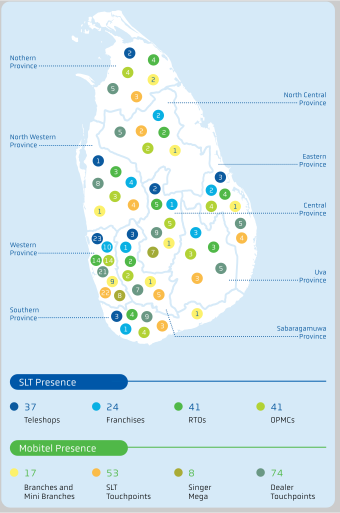
Strategically configured, our pervasive footprint ensures ubiquitous access to its services via a diversified network of customer touchpoints. Advancing its dual mandate of enhancing physical accessibility and expanding digital connectivity, we enable communities to engage with and access reliable high-quality services. The broader objective of promoting digital participation thereby supporting national connectivity targets that translates to financial inclusivity, are institutional commitments the Group upholds, as a key contributor to national development.
Nationwide Reach and Customer-centric Accessibility
SLT’s extensive presence across Sri Lanka is designed to provide seamless access to its services through a variety of customer touchpoints. As the national telecommunications provider, SLT is committed to bridging the gap between physical accessibility and digital connectivity. This focus ensures that customers and communities alike are empowered with reliable and efficient services, reflecting the Group’s dedication to fostering inclusive digital access and supporting the nation’s connectivity goals.
Property, Plant and Equipment (PPE)
Expanding, maintaining, and optimising the our infrastructure is pivotal to an uninterrupted service delivery, and as such the Group concluded its annual PPE maintenance by October 2025.
Facility Management and Governance
Zero-downtime maintenance approach is underpinned by a mature change management, while maintenance windows coordinated with operation teams to deliver uninterrupted service. This approach also helped to ensure asset health though condition-based maintenance and scheduled preventive tasks, extending asset life and control capital expenditure. Enhanced monitoring through power quality meters, thermal imaging, and BMS integration helped detect anomalies early. The Company conducted extensive training programmes in collaboration with engineering institutions, emphasising adherence to standards and safety procedures.
Property Management Committee
A dedicated Property Management Committee (PMC) was set up in 2025, to centralise oversight and elevate stewardship of the Group’s real-estate and infrastructure portfolio. Reporting to the executive leadership, the committee reflects a strategic shift towards integrated asset management for consolidated decision-making and asset health prioritisation, resulting in transparency, auditability, and fiscal prudence.
Power and Cooling
We continued to strengthen the resilience, efficiency, and sustainability of our power and cooling infrastructure during the year through a series of preventive maintenance, energy optimisation, and infrastructure modernisation initiatives. Focused investments in uninterrupted power supply systems and precision cooling infrastructure enhanced operational reliability across critical network and facility environments while supporting long-term cost optimisation and energy efficiency objectives.
Operational improvements included the introduction of new applications for effective system operation management, together with quality enhancement initiatives such as load balancing, UPS system upgrades, power audits, and power factor correction measures. Structured preventive maintenance programmes further improved protection coordination and strengthened the reliability and longevity of generator and UPS handover systems, reducing operational failure risks and improving system resilience.
As part of our ongoing renewable energy transition strategy, solar energy systems were commissioned at the Matara MSU, Pitabeddara, Tangalle, Weligama, Angunakolapellessa, Akuressa, Matara SEA-ME-WE 5 Station, Weveset, Welikada SLT, and Welikada Mobitel facilities during 2025, adding a total installed capacity of 620 kW. This builds on the 19 photovoltaic (PV) solar sites already operational with a combined installed capacity of 904 kW. The Mobitel Welikada facility was also designed to maximise daylight utilisation, reducing dependency on the national grid and supporting more sustainable facility operations.
To further enhance operational continuity under extreme weather conditions, extended annual maintenance contracts were implemented for precision air-conditioning systems and redundancy cooling units. Legacy cooling systems were progressively replaced with more energy-efficient alternatives, while large-scale common equipment rooms were introduced at selected SLT facilities to optimise cooling efficiency and reduce overall energy consumption
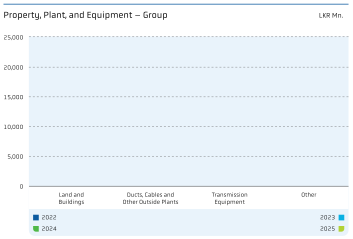
|
2025 LKR Mn. |
2024 LKR Mn. |
2023 LKR Mn. |
2022 LKR Mn. |
|
| Land and buildings | 612 | 530 | 2,107 | 1,728 |
|
Ducts, cables and other outside plants |
12,838 | 12,636 | 23,518 | 20,153 |
| Transmission equipment | 8,700 | 13,011 | 8,251 | 8,697 |
| Other | 2,840 | 3,914 | 3,586 | 2,976 |
Asset Security
Safeguarding a national asset requires minute planning, prudent deployment of resources, monitoring and managing in a cost-effective manner. Remote security systems (CCTV) were installed in many of our asset locations, reducing the cost of manpower.

Outlook for 2026
In 2026, we will continue to accelerate our transformation into a futureready digital technology provider by strengthening next-generation infrastructure, expanding cloud and AI capabilities, and deepening enterprise and public-sector digital enablement initiatives. The Company remains focused on enhancing network resilience, advancing secure digital ecosystems, and delivering scalable technology platforms that support long-term growth, operational agility, and evolving customer requirements.
AI-Ready Data Centre Infrastructure
We plan to further enhance the capabilities of its National Data Centre (NDC) at Pitipana through the deployment of liquid-cooled infrastructure designed to support GPUintensive workloads. The facility will be developed on a modular basis, enabling both local and international colocation customers to host high-performance computing environments and AI-driven applications within a secure and scalable data centre ecosystem.
Additionally, the Company intends to introduce GPU Infrastructure-as-aService (IaaS) offerings through SLT Cloud, enabling enterprise customers to access advanced AI computing capabilities without the need to invest in dedicated GPU environments. These initiatives are expected to strengthen our positioning within Sri Lanka’s emerging AI and digital innovation landscape.
Advancing Software-Defined Data Centre Connectivity
All three data centres located in Colombo, Welikada, and Pitipana currently operate on spine-and-leaf switching architecture supported by Software-Defined Networking (SDN) technologies. Building on this foundation, the planned deployment of a dedicated Data Centre Interconnect (DCI) platform in 2026 will enable the seamless integration of these facilities into a unified multi-data-centre environment.
The implementation of DCI capabilities is expected to enhance high-speed, low-latency connectivity between facilities while supporting the automated deployment of multi-data-centre services, improved operational flexibility, and enhanced service resilience for enterprise and cloud customers.
Strengthening Cybersecurity and Service Reliability
We also plans to further strengthen its cyber resilience and managed services capabilities through the enhancement of Web Application Firewall (WAF) protection across its data centre operations. These capabilities will support improved protection for internet-facing applications while enabling advanced traffic management, including local and global load balancing functionalities.
Moreover, all managed services delivered through Data Centres will continue to be monitored and supported through an enhanced Managed Network Operations Centre (NOC), reinforcing service reliability, operational continuity, and customer service performance.
Expanding the Akaza Cloud Ecosystem
The Akaza Cloud platform will continue to evolve during 2026 through the introduction of additional cloud platforms and service enhancements designed to support enterprise, government, and SME customers. The expansion will further diversify our cloud services portfolio while enabling more flexible, scalable, and cost-efficient deployment models tailored to varying operational and digital transformation requirements.
Facilities Management and Operational Excellence
During 2026, the Facilities Management function will continue to strengthen its focus on operational efficiency, sustainability, and value creation across the Company infrastructure ecosystem. Efforts are underway to progress toward ISO 41001:2018 certification standards, reinforcing internationally aligned facilities management practices across operational environments.
The department is also expected to continue supporting cost optimisation, resource efficiency, infrastructure upkeep, and operational continuity initiatives across our nationwide facilities network. In parallel, ongoing initiatives relating to energy efficiency, logistics optimisation, waste management, and infrastructure support services are expected to further strengthen operational effectiveness while contributing to broader sustainability and business continuity objectives
Additionally, the continued expansion of renewable energy adoption across network infrastructure, including ongoing tower solarisation initiatives, will support improved energy efficiency and long-term operational resilience.